

The tipping point
Exploring what turns an unrealistic environmental dream into a financially viable project, ready for execution on the ground.
At a recent meeting of sugar cane industry players, we learnt how bio-control can be an effective and very cost effective strategy to counter eldana worm. It also became apparent, however, that to convert to biological methods, one has to stop the traditional chemical solution, and then wait until the population of “good bugs” recovers from all the years of spraying, before they can be effective.
It’s that “wait” that’s the problem!
During the wait, the pests could wipe out a crop, or diminish income to the point where the farmer won’t survive the change-over. What businessman would take that risk!
This seems to be a common thread. There is a cost or a risk to converting to more environmentally friendly practices that simply isn’t worth it to the individual farmer, or community who would have to bear that cost or risk.

But what if the beneficiaries of the environmental gains, were to partially back the farmer, or share the risk, in return for the gain that they (and often the farmer) are after?
Let me give you a practical example of a beef farmer on the highland sourveld of KZN. He has a veld farm, and on it he has groves of wattle trees that were there before he was born. If he felled them and converted that land back to veld, he would gain, lets say 60 ha of grazing. But the felling, erosion control, replacement of the woodlot (with one of a more desirable tree species…for storm cover for cattle) , grass planting and five to ten years of weed control, will cost him about R10,000 per hectare.
A farmer recently told me that he had done the sums, and that in the lifetime of him and his son, they will never generate enough beef farming income to cover that. Sixty hectares at R10,000 per hectare: that’s a R600,000 loan from the bank, plus interest. And what NGO would invest R600,000 on a private farm for extra water, the extent of which can’t immediately be measured? The result is that nothing gets done, and the wattle groves stay there. The farmer still wants to get rid of them, and the city below still wants more water, but a generation goes by, wattle seed keeps spreading, and nothing changes.
Maybe we need a catalyst who asks:
How much would company X invest in creating employment opportunities for its CSI score?
How much would municipality Y invest to generate more water to fill the municipal dam?
Is there a risk that can be insured?
How much would the farmer invest to get that land back into beef production?
How much would the local farm-stay put in, to be able to market their venue as part of an environmental project?
How much would the seed company put in as part of an advertisement for their grass seed?
The chances are, that if each of the entities in the above example stretched their budget, right to the brink of what they are comfortable with, and if there was a protagonist with enough passion to get them to the point where they all said “OK, let’s do this!” , that might just be the tipping point that gets the job done and changes the landscape for the better, forever.
At Upland River Conservation we are always searching for the environmental wins that will benefit a catchment (Examples: fencing off river banks, protecting springs, putting in contour belts, planting row crops further from the stream, blocking drains that dried up wet areas, managing for better veld condition……)
We are also thinking about what the costs and risks would be to achieve those wins.
Then we consider who would gain from the work, and in what ways, and how much investment might it justify from them.
We believe that society cannot expect the landowner (farmer or rural community alike) to shoulder the burden of this work. We are passionate about getting the work done. We are looking at building project concepts that reach the tipping point. Call us the passionate protagonist.

Treating floods and droughts with the same medicine
On a recent trip to the UK, I was alerted to the fact that the topic of soils is high on the agenda of environmentalists there. I was visiting various entities involved in river restoration, catchment sensitive farming, and the catchment based approach, and everywhere I went, the topic of soil health was on the lips of my hosts.
The reason for this, is that the UK has been hit by considerable flooding in recent years, and they are fast learning to replace measures such as mechanical dredging, with what they term NFM (Natural Flood Management). The concept is one in which you use the Ecological Infrastructure to protect you from floods instead of, or in support of the “grey infrastructure” (steel and concrete). So they build leaky dams, reconnect rivers with floodplains etc etc. But top of that list, and most widespread, was talk of improving soils, and more specifically their ability to hold onto water for longer, instead of letting go of it as fast as the rain falls upon it.
Now , with me having worded the sentence above as I have, it is probably dawning on you, as it did on me, how managing floods and managing drought, might have overlapping solutions. Keeping rainwater back in the catchment for longer, and stopping it from all rushing away at once, will minimise flood affects and drought affects. Here in SA, we have those 5 or so long dry months in winter, in which our rivers slow to a trickle. End of winter trickle is known as “base flow”. Just as the Poms want to keep water out of the coffee shops along the river Ouse in York, so we would like the rivers to flow stronger through August and September to support all the ecosystems that rely on those rivers (humans not excluded).
And having spongy deep soils that hold onto water achieves both.

The River Ouse in York
Site of considerable flooding

The uMngeni River in September
after long dry months
Studies show that soil with high organic matter levels and good structure, holds more water. In other words, a seldom burnt (not never) , never ploughed, piece of land in the berg, covered in thick natural grass, supplies us with more consistent river feed than a ploughed maize field where the trash is burnt every year.
These two are extremes….the berg and the maize field….. but more commonly the answer lies in subtleties of management in a vast area of grazed and burnt veld landscape. Farmers have the challenge of trying to maximise the tonnage of grass for their cows, while preserving a diversity of species, while keeping costs down and income up. Certain grazing and burning practices favour less palatable species. Other practices can result in poor basal cover (a lower number of plants per ha, which leaves bare ground between), and still more nuanced techniques give higher grass yield in wet years, or maybe in dry years, but probably not both. Farming neighbours are often dismissive of one another’s techniques. Fire regulations impose boundaries to what one can do, and every valley is different. Scientists from the varsity have vast research based knowledge. Farmers have vast local knowledge. National magazines can publish articles on best practice that are controversial, and not nationally applicable.
So what is best practice for drought and flood management?
The answer probably lies in area specific study groups, where scientists and farmers work together to establish their own unique best practice, for widest possible adoption in their own valley. The chances are, that despite the fact that we have farmed this land for over a hundred years, there will be some experimentation too.
Some reading matter on the topic:
What are the problems caused by wattle
Wattle trees are more problematic than you think. They don’t only sap valuable water….
The common and simple message about wattle, is that it sucks more water out of the catchment than indigenous vegetation. If that were the only problem with wattle, we would march out there and poison the lot and walk away. Until now several agencies have done just that. Doing that is a problem! It is an issue because in doing only that, one has not solved the problem at all. The need to understand the difficulties about wattle is therefore important when planning the removal of a wattle grove, including the timeline, resources and budget you may need.
Wattle does indeed sap a lot of water. I have heard figures of 1300 to 1600mm per annum. Rainfall in the area where we work is between 800 and 1200mm per annum.
Other important effects of wattle relate to the allelopathic effect, in which the plant prevents other species from growing in its leaf zone. I explore that on a real site outdoors in this video here:

Apart from how much water they draw, consider these aspects: Andrew takes us through a grove of wattle trees and shows real examples of the harm that they can do.
Another aspect to consider, is that wattle seed remains viable (i.e. they can germinate) for a whopping 60 years after they land on the ground! Wattle seeds are also triggered to germinate by fire.
As a legume, wattle puts some nitrogen into the soil. In addition, it causes the wash away of topsoil. Take a look at this explanatory video: wattle problems explained It also acidifies the soil. If you add all these factors together, it means that a patch of felled wattle will only be suitable habitat to a particular suite of species. Those species are pioneer species, and most are alien and themselves invasive. This is very evident in the field. One cannot wish grassland back! It is really hard work, and no one has nailed the formula of what to do, when the patch becomes a jungle of blackjack, wattle saplings, khaki bos, and bug weed. It is certainly easier if you patch is on flat land, accessible by tractor, and if the area has been de-stumped. I say this because continual mowing works really well in getting grasses back in there. But in the steep and sometimes remote valleys, this is not possible.
This business of wattle removal is therefore maturing into a more holistic field of “grassland re-establishment”, of which the initial felling, and even the first year or two of follow up, are very clearly just the beginning.
From a paper by Yapi, O’Farrell, Dziba and Esler, we learn:
“ active restoration is required to enhance ecosystem recovery (Beater et al. 2008; Gaertner et al. 2011; Le Maitre et al. 2011). In some cases, elevated levels of soil nutrients (Yelenik et al. 2007; Gaertner et al. 2011; Witkowski 2012) derived from nutrient rich litter, and N fixation in the case of legumes, can lead to the undesirable situation of reinvasion by the same and or other species after clearing”
So in summary, wattle causes erosion and sucks water, and its other, and equally significant problems manifest when you cut it down.
Further reading:

Re establishing grassland
What to do after the wattle is gone…

Re establishing grassland
Its not easy!
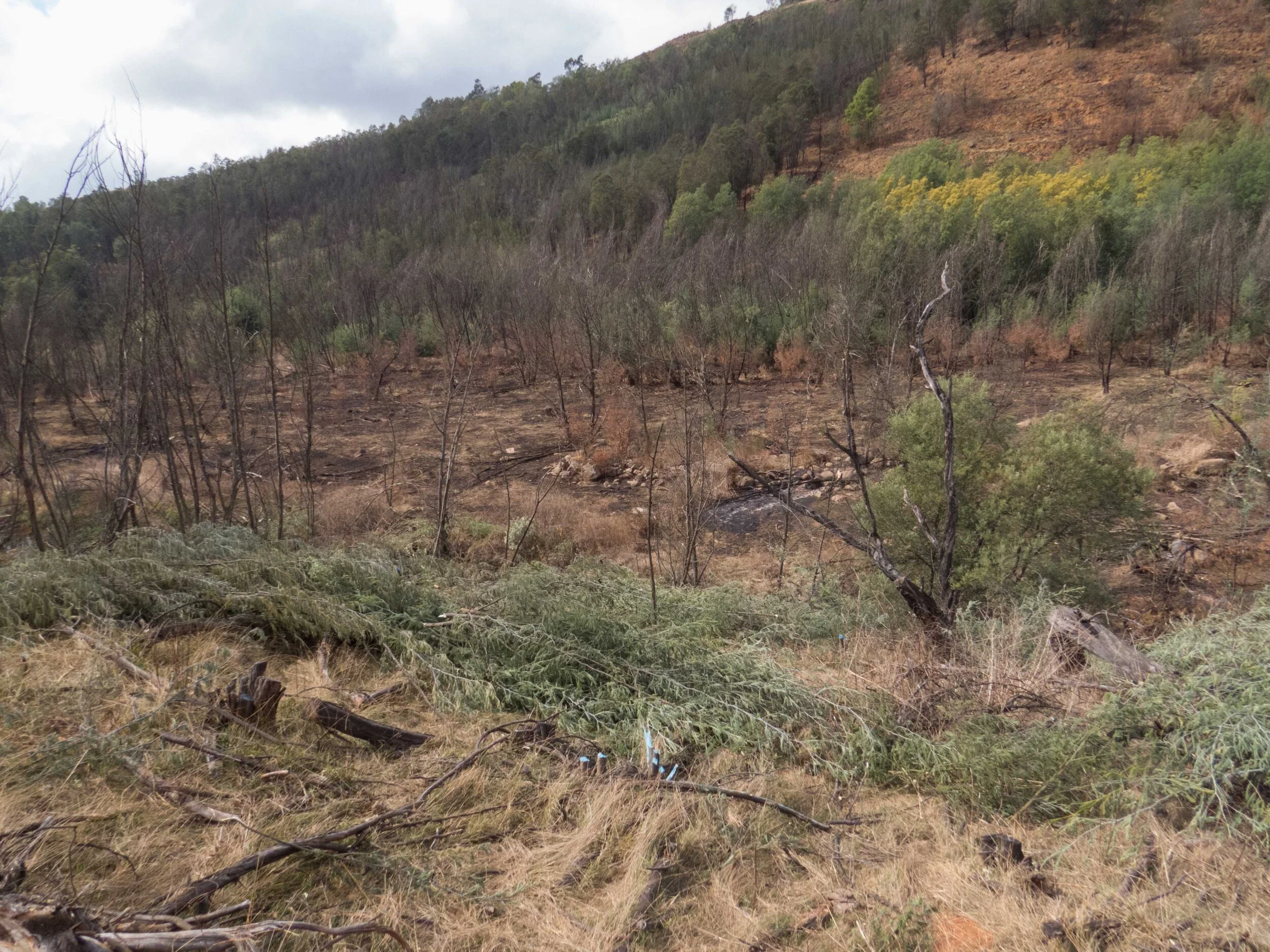
Re-establishing grassland is not easy! After removal of wattle, one inevitably ends up with bare earth, somewhat rich in nitrogen from the legume effect of wattle, arguably still affected by Wattle’s allelopathic effect, and littered with woody debris. Going from this to dense grassland does not happen easily. In fact, it could be argued that this step is more difficult than the task of removing the trees themselves.
For one thing a fire may have gone through the landscape. This could be a natural occurrence, or a move by the landowner to “tidy up”. Burning is also not necessarily wrong. In fact one school of thought is to burn regularly, so as to trigger germination of the huge bank of wattle seed, as a means of ‘flushing it out’. There is real merit in this. But if the trash has been piled high, the fire will have been damagingly hot, and the earth will be baked and laid bare. The pulverised, baked earth is often best described as orange talcum powder. It has no structure, is hydrophobic, and nothing will grow in it. It represents a real erosion hazard!
Quite aside from burn areas, the ground is receptive to pioneer species, most of which are alien. Blackjacks (bidens pilosa), Khakhi bos, and other tall species grow. They have a poor basal cover, but are better than bare earth. The challenge is to get desirable species in before those weeds can predominate and shade out the species we would like to see. By all accounts, seeding a mix representative of highland sourveld is something that has never succeeded. Locally, a “summer veld mix” can be bought, and although it is not fully representative of the highland species mix, it comes as close as one can get. Initially we preferred a mix of Lovegrass and Teff (Eragrostis curvula and Eragrostis teff). Teff is indigenous to Ethiopia, but it is an annual and does not re-seed. Its advantage is that it germinates quickly to hold the soil, and will attract cattle, bearing other species in their dung. The curvula takes longer to germinate but does come away well in the end. The problem is that the teff does not germinate if merely scattered on the site: it must be raked in. It also will not germinate if there is a dry hot spell of weather. Also, the curvula tends to dominate and not allow the natural ingress of a diversity of species. So we use the “summer Veld Mix”, and we seem to be having success.
This quote from Grassland habitat restoration by Smith, Diaz and Winder , sums it up well:
“We conclude that there is no “quick fix” for the establishment of a grassland community; long-term monitoring provides useful information on the trajectory of community development; sowing gets you something ,but it may not be the target vegetation you want that is difficult to establish and regenerate; it is important to sow a diverse mix as subsequent recruitment opportunities are probably limited; post-establishment management should be explored further and carefully considered as part of a restoration project.”
and from Farmers Weekly:
“Effective restoration of encroached areas is not a short-term project, but a long-term commitment. “Chopping down a few trees and using a bit of poison here and there won’t solve the problem. There’s no quick-fix – you need a management plan as well as a budget if you want to succeed,” says Arnaud. “But,” he adds, “the rewards pay off as the land becomes more productive and animals can flourish.”
Our best summary of the way to do it, will follow in further posts…….